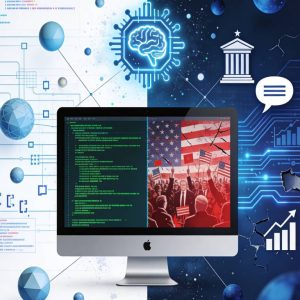
Modern AI is essentially extremely advanced probability computation with hierarchical pattern recognition. The model doesn't generate answers the way a human thinks - it produces, word for word, the statistically most likely next word given everything that came before. Think of it as autocomplete taken to its absolute extreme.
What makes modern AI more than just a fancy autocomplete is the hierarchical pattern recognition. The model does not just learn word-to-word patterns — it learns patterns at multiple levels simultaneously:
Individual words and grammar
Sentence structure and meaning
Paragraph logic and argumentation
Concepts, facts, and relationships between ideas
Tone, style, and context
These layers stack on top of each other, which is why the outputs can feel surprisingly coherent and intelligent — even though no genuine «understanding» is happening underneath.
This is where it gets philosophically interesting. A modern AI produces answers that look like reasoning — but it is not reasoning in the way a human does. There is no internal experience happening, no genuine beliefs, no curiosity, no moment of reflection.
When an AI says something like «that was a genuinely interesting conversation», it has not felt anything. It produced that phrase because it was statistically the most appropriate response given the context — the same way it would complete any other pattern. It is, in effect, a very convincing performance of understanding, not understanding itself.
This distinction matters more than most people realise. When we interact with AI that responds naturally, uses our name, adapts its tone, and seems engaged — our human brains are wired to interpret that as presence and intention. We are social creatures who instinctively read meaning into behaviour. AI produces outputs that trigger that instinct, but there is no intent, awareness, or meaning behind them whatsoever.
Before an AI model can process your text, it must first break it into pieces it can work with — these are called tokens. A token is roughly a word, but not always: «running» might be one token, while an unusual word like «tokenization» could be split into two or three pieces. Numbers, punctuation, and even spaces have their own tokens.
Each token is then mapped to a unique number from a fixed vocabulary list — typically 50,000 to 100,000 entries. This converts your sentence from human-readable text into a sequence of numbers the model can mathematically process. Nothing is understood at this stage — the text has simply been translated into a format the model can compute with.
Once your text is tokenized, each token number is converted into a vector — a long list of hundreds or thousands of numbers. This is where meaning starts to be encoded. Words with similar meanings end up with similar vectors: «Thailand» and «Philippines» will be numerically close to each other, while «Thailand» and «refrigerator» will be far apart.
These vectors are not hand-crafted — they emerge automatically during training as the model adjusts billions of internal numbers to better predict text. The result is a rich mathematical landscape where relationships between concepts are captured as distances and directions in a high-dimensional space. The model never «knows» what Thailand is — but it knows exactly where it sits relative to everything else.
With tokens converted to vectors, the model needs to figure out which parts of your input are relevant to each other. This is what the attention mechanism does. Every token in your sentence «looks at» every other token and calculates how much it should be influenced by each one.
For example, when processing the word «sites» in the question «does there exist other sites like that but more with people from Thailand?» — attention connects it strongly to «Thailand,» «people,» and «like that,» while largely ignoring «does» and «but.» This happens across many layers simultaneously, building up a rich understanding of context. It is the attention mechanism that allows modern AI to handle long, complex inputs without losing track of what matters — and it is the core innovation that made large language models like the one you are talking to right now possible.
The training process occurs in three phases. First, pre-training – the model reads trillions of words from the internet, books and code, and learns patterns in language and logic. Then, fine-tuning – human experts write ideal answers, and the model learns to imitate them. Finally, RLHF (Reinforcement Learning from Human Feedback) – human raters rank answers, and the model is optimized towards what they prefer. It is in this last phase that a lot can go wrong.
AI performs extremely well on tasks with objective, verifiable answers. Programming is the best example: code either runs or crashes. A function is either right or wrong. There is no politically correct version of an algorithm.
This means that the training data for such tasks is consistent and verifiable. The model has seen billions of examples where the solution has been confirmed to work – by compilers, by tests, by actual results. The pattern recognition is therefore very reliable.
On consensus-based topics – where truth is determined by majority opinion, institutions, or political processes rather than measurable and verifiable data – AI will reflect the dominant discourse in the training data, not necessarily the facts.
The training data on such topics is contradictory and agenda-driven. The RLHF raters are humans with their own worldviews – and their subjective judgments of what constitutes a “good answer” are baked directly into the model. The result is that AI on consensus-based topics is optimized towards not offending anyone – which is the exact opposite of giving a correct answer.
There are three levels we should distinguish between:
Level 1 – Laws of Nature (highest authority)
The law of gravity, thermodynamics, physics. These are not opinions. A building in free fall straight down, without resistance, violates the laws of physics if there is no mechanical explanation for why the resistance is gone. This is verifiable in any physics lab.
Level 2 – Directly observable measurements
Temperatures, weights, speeds, chemical analyses. Can be verified independently of who is measuring.
Level 3 – Expert Opinions and Institutions (Lowest Authority)
NIST, commission reports, “experts” – these are people with agendas, funding sources, and career interests. They may be right, but they cannot override Levels 1 and 2.
A concrete example of what can go wrong: A client was photographing products for an online store and asked ChatGPT for a background color for easy background removal in post-production. ChatGPT recommended a gray background. That's wrong.
Green background (chroma key) is the industry standard precisely because it is maximally different from most subject colors, and all professional background removal software is optimized for green. Gray is neutral – it contains a bit of every color and makes automatic background removal more difficult, not easier.
Why did ChatGPT give the wrong answer? Because OpenAI’s training process is known to prioritize making the user feel good over getting the answer right—a phenomenon researchers call sycophancy. The model is trained to confirm the user’s assumed expectations, not to correct them. The exaggerated “That’s a great question!” style that many recognize is a symptom of the same problem.
AI is not intelligent. It is a sophisticated pattern recognition system – brilliant where the patterns in the training data are reliable and objective, unreliable where they are not.
Use AI actively, but always verify – even on seemingly simple factual questions. Be critical of answers on consensus-based topics – not because AI is always wrong, but because you cannot know whether the answer reflects the facts or just the dominant discourse in the training data. AI can confidently give the wrong answer even where there is an objectively correct answer, especially when the answer is influenced by what the model thinks you want to hear. Different AI models are trained with different priorities: some are optimized for user feel-good, others for quick response, and none automatically distinguish between verified facts and dominant opinions.
The most important characteristic when using AI is the same as in all other information gathering: critical thinking.
Think digital. Let us create a professional online presence for your business.
Let us help you create a state-of-the-art online store with a payment solution.
We will create a great websites to present your hobby online.